EQUATION OF CIRCLE
Definition:
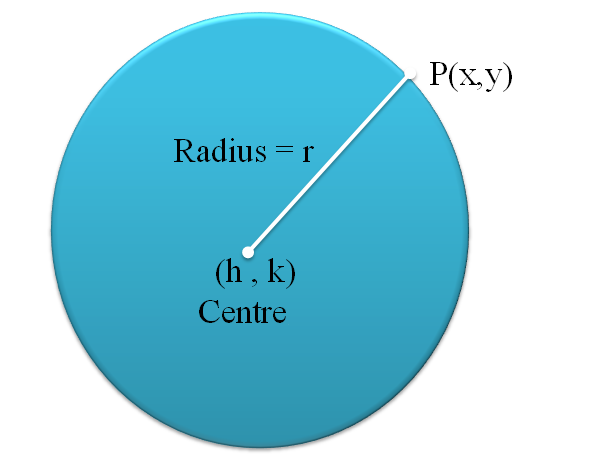
A circle is the locus of a point which moves in a plane in such a way that its distance from a fixed point remains constant. The fixed point is called the centre of the circle and the constant distance is called the radius of the circle.
Equation of the circle with centre (h, k) and radius ‘r’ units.
CP = r
\[\sqrt{(x\ -\ h)^2\ +\ (y\ -\ k)^2}\ =\ r\ (Using\ distance\ formula)\]
\[(x\ -\ h)^2\ +\ (y\ -\ k)^2\ =\ r^2\]
Note:
The equation of the circle with centre (0, 0 ) and radius ‘r’ units is x2 + y2 = r2
\[\color {purple} {Example\ 1\ .}\ \color {red} {What\ is\ the\ equation\ of\ the\ circle}\ with\ centre\ at\ origin\ and\ radius\ 1\ unit?\ \hspace{15cm}\]
\[\color {blue} { Soln:}\ \hspace{20cm}\]
\[We\ know\ that\ the\ equation\ of\ circle\ is\ (x\ -\ h)^2\ +\ (y\ -\ k)^2\ =\ r^2\]
\[Given\ h\ =\ 0,\ k = 0\ and\ r\ =\ 1\]
\[(x\ -\ 0)^2\ +\ (y\ -\ 0)^2\ =\ 1^2\]
\[x^2\ +\ y^2\ =\ 1\]
\[The\ equation\ of\ the\ circle\ is\ \boxed{x^2\ +\ y^2\ -\ 1=\ 0}\]
VIDEO
\[\color {purple} {Example\ 2\ .}\ \color {red} {Find\ the\ equation\ of\ the\ circle}\ with\ centre\ (-5, 7)\ and\ radius\ 5\ units.\ \hspace{5cm}\]
\[\color {blue} { Soln:}\ Given\ centre\ =\ (-5, 7)\ \hspace{4cm}\ and\ radius\ =\ 5\ \hspace{6cm}\]
\[We\ know\ that\ the\ equation\ of\ circle\ is\ (x\ -\ h)^2\ +\ (y\ -\ k)^2\ =\ r^2\]
\[Given\ h\ =\ -\ 5,\ k = 7\ and\ r\ =\ 5\]
\[(x\ +\ 5)^2\ +\ (y\ -\ 7)^2\ =\ 5^2\]
\[x^2\ +\ 10\ x\ +\ 25\ +\ y^2\ -\ 14y\ +\ 49\ =\ 25\ \hspace{10cm}\]
\[x^2\ +\ y^2\ +\ 10\ x\ -\ 14y\ +\ 25\ +\ 49\ -\ 25\ =\ 0\ \hspace{10cm}\]
\[x^2\ +\ y^2\ +\ 10\ x\ -\ 14y\ +\ 49\ =\ 0\ \hspace{10cm}\]
\[\therefore\
The\ required\ equation\ of\ the\ circle\ is\ \hspace{7cm}\]
\[\boxed{x^2\ +\ y^2\ +\ 10\ x\ -\ 14\ y\ +\ 49\ =\ 0}\ \hspace{5cm}\]
VIDEO
General equation of the circle: x2 + y2 + 2gx + 2fy + c = 0
Centre = (-g , -f ) and radius r = √( g2 + f2 – c)
\[\color {purple}{Example\ 3\ .}\ \color {red} {Find\ the\ centre\ and\ radius\ of\ the\ circle}\ x^2\ +\ y^2\ =\ 25\ \hspace{5cm}\]
\[\hspace{5cm}\ April\ 2024\]
\[\color {blue} { Soln:}\ Given\ x^2\ +\ y^2\ =\ 25\ \hspace{10cm}\]
\[We\ know\ that\ the\ equation\ of\ circle\ is\ x^2\ +\ y^2\ +\ 2\ g\ x\ +\ 2\ f\ y\ +\ c\ =\ 0\ \hspace{10cm}\]
\[2\ g\ =\ 0\ \hspace{3cm}\ 2\ f\ =\ 0\ \hspace{3cm}\ c\ =\ -25\]
\[g\ =\ 0\ \hspace{3cm}\ f\ =\ 0\ \hspace{3cm}\]
\[centre\ =\ (-\ g,\ -\ f)\ \hspace{4cm}\ r\ =\ \sqrt{(g^2\ +\ f^2\ -\ c)}\]
\[centre\ =\ (0,\ 0)\ \hspace{4cm}\ r\ =\ \sqrt{(0^2\ +\ 0^2\ +\ 25)}\]
\[\hspace{6cm}\ r\ =\ \sqrt{25}\ =\ 5\]
\[\fbox{centre = (0, 0) r = 5}\]
\[\color {purple} {Example\ 4\ .}\ \color {red} {Find\ the\ centre\ and\ radius\ of\ the\ circle}\ x^2\ +\ y^2\ +\ 2\ x\ +\ 2\ y\ -\ 7\ =\ 0\ \hspace{5cm}\]
\[\color {blue} { Soln:}\ Given\ x^2\ +\ y^2\ +\ 2\ x\ +\ 2\ y\ -\ 7\ =\ 0\ \hspace{10cm}\]
\[We\ know\ that\ the\ equation\ of\ circle\ is\ x^2\ +\ y^2\ +\ 2\ g\ x\ +\ 2\ f\ y\ +\ c\ =\ 0\ \hspace{10cm}\]
\[2\ g\ =\ 2\ \hspace{3cm}\ 2\ f\ =\ 2\ \hspace{3cm}\ c\ =\ -7\]
\[g\ =\ 1\ \hspace{3cm}\ f\ =\ 1\ \hspace{3cm}\]
\[centre\ =\ (-\ g,\ -\ f)\ \hspace{4cm}\ r\ =\ \sqrt{(g^2\ +\ f^2\ -\ c)}\]
\[centre\ =\ (-\ 1,\ -\ 1)\ \hspace{4cm}\ r\ =\ \sqrt{(1^2\ +\ 1^2\ +\ 7)}\]
\[\hspace{6cm}\ r\ =\ \sqrt{(1\ +\ 1\ +\ 7)}\]
\[\hspace{6cm}\ r\ =\ \sqrt{9}\ =\ 3\]
\[\fbox{centre = (- 1, – 1) r = 3}\]
VIDEO
\[\color {purple}{Example\ 5\ .}\ \color {red} {Find\ the\ centre\ and\ radius\ of\ the\ circle}\ x^2\ +\ y^2\ -\ 4\ x\ +\ 8\ y\ -\ 5\ =\ 0\ \hspace{5cm}\]
\[ \color {blue} {Soln:}\ Given\ x^2\ +\ y^2\ -\ 4\ x\ +\ 8\ y\ -\ 5\ =\ 0\ \hspace{10cm}\]
\[We\ know\ that\ the\ equation\ of\ circle\ is\ x^2\ +\ y^2\ +\ 2\ g\ x\ +\ 2\ f\ y\ +\ c\ =\ 0\ \hspace{10cm}\]
\[2\ g\ =\ -\ 4\ \hspace{3cm}\ 2\ f\ =\ 8\ \hspace{3cm}\ c\ =\ -\ 5\]
\[g\ =\ -\ 2\ \hspace{3cm}\ f\ =\ 4\ \hspace{3cm}\]
\[centre\ =\ (-\ g,\ -\ f)\ \hspace{4cm}\ r\ =\ \sqrt{g^2\ +\ f^2\ -\ c}\]
\[centre\ =\ (2,\ -\ 4)\ \hspace{4cm}\ r\ =\ \sqrt{(-\ 2)^2\ +\ 4^2\ +\ 5}\]
\[\hspace{6cm}\ r\ =\ \sqrt{4\ +\ 16\ +\ 5}\]
\[\hspace{6cm}\ r\ =\ \sqrt{25}\]
\[\fbox{centre = (2, – 4) r = 5}\]
VIDEO
\[\color {purple} {Example\ 6\ .}\ \color {red} {Find\ the\ centre\ and\ radius\ of\ the\ circle}\ x^2\ +\ y^2\ -\ 8\ y\ +\ 3\ =\ 0\ \hspace{5cm}\]
\[\hspace{5cm}\ October\ 2023\]
\[\color {blue} {Soln:}\ Given\ x^2\ +\ y^2\ -\ 8\ y\ +\ 3\ =\ 0\ \hspace{10cm}\]
\[We\ know\ that\ the\ equation\ of\ circle\ is\ x^2\ +\ y^2\ +\ 2\ g\ x\ +\ 2\ f\ y\ +\ c\ =\ 0\ \hspace{10cm}\]
\[2\ g\ =\ 0\ \hspace{3cm}\ 2\ f\ =\ -\ 8\ \hspace{3cm}\ c\ =\ 3\]
\[g\ =\ 0\ \hspace{3cm}\ f\ =\ -\ 4\ \hspace{3cm}\]
\[centre\ =\ (-\ g,\ -\ f)\ \hspace{4cm}\ r\ =\ \sqrt{(g^2\ +\ f^2\ -\ c)}\]
\[centre\ =\ (0,\ 4)\ \hspace{4cm}\ r\ =\ \sqrt{(0^2\ +\ (-4)^2\ -\ 3)}\]
\[\hspace{6cm}\ r\ =\ \sqrt{(0\ +\ 16\ -\ 3)}\]
\[\hspace{6cm}\ r\ =\ \sqrt{13}\]
\[centre = (0, 4)\ \hspace{5cm}\ r\ =\ \sqrt{13}\]
VIDEO
\[\color {purple} {Example\ 6:}\ \color {red} {Show\ that\ the\ straight\ line}\ 4\ x-\ y\ =\ 17\ passes\ through\ \hspace{15cm}\]\[the\ centre\ of\ the\ circle\ x^2\ +\ y^2\ -\ 8\ x\ +\ 2\ y\ +\ 3\ =\ 0\ \hspace{5cm}\]
\[\color {blue} { Soln:}\ Given\ x^2\ +\ y^2\ -\ 8\ x\ +\ 2\ y\ +\ 3\ =\ 0\ \hspace{10cm}\]
\[We\ know\ that\ the\ equation\ of\ circle\ is\ x^2\ +\ y^2\ +\ 2\ g\ x\ +\ 2\ f\ y\ +\ c\ =\ 0\ \hspace{10cm}\]
\[2\ g\ =\ -\ 8\ \hspace{3cm}\ 2\ f\ =\ 2\ \hspace{3cm}\ c\ =\ 3\]
\[g\ =\ -\ 4\ \hspace{3cm}\ f\ =\ 1\ \hspace{3cm}\]
\[centre\ =\ (-\ g,\ -\ f)\]
\[centre\ =\ (4,\ -\ 1)\]
\[4x\ -\ y=\ 17\ ——–(1)\ \hspace{10cm}\]
\[put\ x\ =\ 4,\ y\ =\ -\ 1\ in\ equation\ (1)\]
\[4(4)\ – (-1)\ =\ 17\]
\[17\ =\ 17\]
\[(4, -1)\ satisfies\ (1)\]
\[Hence\ the\ straight\ line\ 4\ x-\ y\ =\ 17\ passes\ through\ \hspace{15cm}\]\[the\ centre\ of\ the\ circle\ x^2\ +\ y^2\ -\ 8\ x\ +\ 2\ y\ +\ 3\ =\ 0\]
VIDEO
\[\color {purple} {Example\ 7:}\ \color {red} {Find\ the\ equation\ of\ the\ circle}\ \hspace{10cm}\]\[passing\ through\ the\ point\ A(2 ,-3)\ and\ having\ its\ centre\ at\ C(-5, 1)\ \hspace{5cm}\]
\[\color {blue} {Soln:}\ r\ =\ \sqrt{(-\ 5\ -\ 2)^2\ +\ (1\ +\ 3)^2}\ \hspace{15cm}\]
\[=\ \sqrt{(-7)^2\ +\ (4)^2}\ \hspace{10cm}\]
\[=\ \sqrt{49\ +\ 16}\ \hspace{10cm}\]
\[r=\ \sqrt{65}\ \hspace{10cm}\]
\[We\ know\ that\ the\ equation\ of\ circle\ is\ (x\ -\ h)^2\ +\ (y\ -k)^2\ =\ r^2\ \hspace{7cm}\]
\[Here\ h\ =\ -\ 5,\ k\ =\ 1\ (Given)\ and\ r\ =\ \sqrt{65}\ \hspace{10cm}\]
\[(x\ +\ 5)^2\ +\ (y\ -\ 1)^2\ =\ (\sqrt{65})^2\ \hspace{10cm}\]
\[x^2\ +\ 10\ x\ +\ 25\ +\ y^2\ -\ 2y\ +\ 1\ =\ 65\ \hspace{10cm}\]
\[x^2\ +\ y^2\ +\ 10\ x\ -\ 2y\ +\ 26\ -\ 65\ =\ 0\ \hspace{10cm}\]
\[x^2\ +\ y^2\ +\ 10\ x\ -\ 2y\ -\ 39\ =\ 0\ \hspace{10cm}\]
\[\therefore\ The\ required\ equation\ of\ the\ circle\ is\ \hspace{7cm}\]
\[\boxed{x^2\ +\ y^2\ +\ 10\ x\ -\ 2y\ -\ 39\ =\ 0}\ \hspace{5cm}\]
VIDEO
\[\color {purple} {Example\ 8:}\ \color {red} {Find\ the\ equation\ of\ the\ circle}\ \hspace{10cm}\]\[having\ centre\ (2,-1)\ and\ passing\ through\ the\ point\ (8,7)\ \hspace{5cm}\]
\[\color {blue} {Soln:}\ r\ =\ \sqrt{(8\ -\ 2)^2\ +\ (7\ +\ 1)^2}\ \hspace{15cm}\]
\[=\ \sqrt{(6)^2\ +\ (8)^2}\ \hspace{10cm}\]
\[=\ \sqrt{36\ +\ 64}\ \hspace{10cm}\]
\[r=\ \sqrt{100}\ =\ 10\ \hspace{10cm}\]
\[We\ know\ that\ the\ equation\ of\ circle\ is\ (x\ -\ h)^2\ +\ (y\ -k)^2\ =\ r^2\ \hspace{7cm}\]
\[Here\ h\ =\ 2,\ k\ =\ -\ 1\ (Given)\ and\ r\ =\ 10\ \hspace{10cm}\]
\[(x\ -\ 2)^2\ +\ (y\ +\ 1)^2\ =\ 10^2\ \hspace{10cm}\]
\[x^2\ -\ 4\ x\ +\ 4\ +\ y^2\ +\ 2y\ +\ 1\ =\ 100\ \hspace{10cm}\]
\[x^2\ +\ y^2\ -\ 4\ x\ +\ 2y\ +\ 5\ -\ 100\ =\ 0\ \hspace{10cm}\]
\[x^2\ +\ y^2\ -\ 4\ x\ +\ 2y\ -\ 95 =\ 0\ \hspace{10cm}\]
\[\therefore\ the\ required\ equation\ of\ the\ circle\ is\ \hspace{7cm}\]
\[\boxed{x^2\ +\ y^2\ -\ 4\ x\ +\ 2y\ -\ 95\ =\ 0}\ \hspace{5cm}\]
VIDEO
Equation of circle on the line joining the points ( x1 , y1 ) and ( x2 , y2 ) as diameter : \[(x\ -\ x_1)(x\ -\ x_2)\ +\ (y\ -\ y_1)(y\ -\ y_2)\ =\ 0\]
\[\color {purple} {Example\ 9:}\ \color {red} {Find\ the\ equation\ of\ the\ circle}\ on\ the\ line\ joining\ the\ points\ (2,3),\ (-\ 4,\ 5)\ as\ diameter.\]\[\color{red}{Aslo\ find\ the\ centre\ and\ radius}\ of\ the\ circle\ \hspace{5cm}\]
\[\hspace{5cm}\ April\ 2024\]
\[\color {blue} {Soln:}\ \hspace{18cm}\]
\[(x\ -\ x_1)(x\ -\ x_2)\ +\ (y\ -\ y_1)(y\ -\ y_2)\ =\ 0\]
\[Given\ x_1\ =\ 2,\ y_1\ =\ 3,\ x_2\ =\ -\ 4,\ y_2\ =\ 5\]
\[(x\ -\ 2)(x\ +\ 4)\ +\ (y\ -\ 3)(y\ -\ 5)\ =\ 0\]
\[x^2\ +\ 4\ x\ – 2\ x\ – \ 8\ +\ y^2\ -\ 5y\ -\ 3y\ +\ 15\ =\ 0\]
\[x^2\ +\ 2\ x\ +\ y^2\ -\ 8y\ +\ 7\ =\ 0\]
\[x^2\ +\ y^2\ +\ 2\ x\ -\ 8y\ +\ 7\ =\ 0\]
\[\therefore\ the\ equation\ of\ the\ circle\ is\ \hspace{7cm}\]
\[\boxed{x^2\ +\ y^2\ +\ 2\ x\ -\ 8\ y\ +\ 7\ =\ 0}\ \hspace{5cm}\]
\[comparing\ with\ x^2\ +\ y^2\ +\ 2\ g\ x\ +\ 2\ f\ y\ +\ c\ =\ 0\]
\[2\ g\ =\ 2\ \hspace{3cm}\ 2\ f\ =\ -\ 8\ \hspace{3cm}\ c\ =\ 7\]
\[g\ =\ 1\ \hspace{3cm}\ f\ =\ -\ 4\ \hspace{3cm}\]
\[centre\ =\ (-\ g,\ -\ f)\ \hspace{4cm}\ r\ =\ \sqrt{g^2\ +\ f^2\ -\ c}\]
\[centre\ =\ (-\ 1,\ 4)\ \hspace{4cm}\ r\ =\ \sqrt{1^2\ +\ (-4)^2\ -\ 7}\]
\[\hspace{6cm}\ r\ =\ \sqrt{1\ +\ 16\ -\ 7}\]
\[\hspace{6cm}\ r\ =\ \sqrt{17\ -\ 7}\]
\[\hspace{6cm}\ r\ =\ \sqrt{10}\]
\[\boxed{centre = (- 1, 4)\ \hspace{4cm}\ r\ =\ \sqrt{10}}\]
VIDEO
\[\color {purple} {Example\ 10}\ \color {red} {Find\ the\ equation\ of\ the\ circle}\ two\ of\ whose\ diameters\ are\ \hspace{15cm}\]\[x\ +\ y\ =\ 6\ and\ x\ +\ 2y=\ 4\ and\ its\ radius\ is\ 10\ units\ \hspace{10cm}\]
\[\color {blue} {Soln:}\ x\ +\ y\ =\ 6\ ————–\ (1)\ \hspace{15cm}\]
\[x\ +\ 2y\ =\ 4\ ————–\ (2)\ \hspace{15cm}\]
\[(1)\ -\ (2)\ \implies\ -\ y\ =\ 2\ \hspace{10cm}\]
\[\therefore\ \boxed{y\ =\ -\ 2}\ \hspace{10cm}\]
\[Substitute\ y\ =\ -\ 2\ in\ (1)\ \hspace{10cm}\]
\[x\ -\ 2\ =\ 6\ \hspace{10cm}\]
\[x\ =\ 6\ +\ 2\ \hspace{10cm}\]
\[\therefore\ \boxed{x\ =\ 8}\ \hspace{10cm}\]
\[Centre\ =\ (8,\ -2)\ \hspace{10cm}\]
\[We\ know\ that\ the\ equation\ of\ circle\ is\ (x\ -\ h)^2\ +\ (y\ -k)^2\ =\ r^2\ \hspace{7cm}\]
\[Here\ h\ =\ 8,\ k\ =\ -\ 2\ and\ r\ =\ 10\ \hspace{10cm}\]
\[(x\ -\ 8)^2\ +\ (y\ +\ 2)^2\ =\ 10^2\ \hspace{10cm}\]
\[x^2\ -\ 16\ x\ +\ 64\ +\ y^2\ +\ 4y\ +\ 4\ =\ 100\ \hspace{10cm}\]
\[x^2\ +\ y^2\ -\ 16\ x\ +\ 4y\ +\ 68\ =\ 100\ \hspace{10cm}\]
\[x^2\ +\ y^2\ -\ 16\ x\ +\ 4y\ +\ 68\ -\ 100\ =\ 0\ \hspace{10cm}\]
\[\therefore\ The\ equation\ of\ the\ circle\ is\ \hspace{7cm}\]
\[\boxed{x^2\ +\ y^2\ -\ 16\ x\ +\ 4\ y\ -\ 32\ =\ 0}\ \hspace{5cm}\]
\[\color {purple} {Example\ 11}\ \color {red} {Find\ the\ equation\ of\ the\ circle}\ \ passing\ through\ (2, 4)\ and\ whose\ diameters\ are\ \hspace{15cm}\]\[x\ -\ y\ =\ 4\ and\ 2x\ +\ 3y=\ -\ 7\ \hspace{5cm}\]
\[\color {blue} {Soln:}\ x\ -\ y\ =\ 4\ ————–\ (1)\ \hspace{15cm}\]
\[2x\ +\ 3y=\ -\ 7\ ————–\ (2)\ \hspace{5cm}\]
\[(1) \times\ 2\ and\ (1)\ -\ (2)\ \implies\ -\ 5y\ =\ 15\ \hspace{10cm}\]
\[\therefore\ \boxed{y\ =\ -\ 3}\ \hspace{10cm}\]
\[Substitute\ y\ =\ -\ 3\ in\ (1)\ \hspace{10cm}\]
\[x\ -\ y\ =\ 4\ \hspace{10cm}\]
\[x\ +\ 3\ =\ 4\ \hspace{10cm}\]
\[x\ =\ 4\ -\ 3\ \hspace{10cm}\]
\[\therefore\ \boxed{x\ =\ 1}\ \hspace{10cm}\]
\[Centre\ =\ (1,\ -\ 3)\ \hspace{10cm}\]
\[r\ =\ \sqrt{(1\ -\ 2)^2\ +\ (-3\ -\ 4)^2}\ \hspace{10cm}\]
\[=\ \sqrt{(-1)^2\ +\ (-\ 7)^2}\ \hspace{10cm}\]
\[=\ \sqrt{1\ +\ 49}\ \hspace{10cm}\]
\[r=\ \sqrt{50}\ \hspace{10cm}\]
\[We\ know\ that\ the\ equation\ of\ circle\ is\ (x\ -\ h)^2\ +\ (y\ -k)^2\ =\ r^2\ \hspace{7cm}\]
\[Here\ h\ =\ 1,\ k\ =\ -\ 3\ (Given)\ and\ r\ =\ \sqrt{50}\ \hspace{10cm}\]
\[(x\ -\ 1)^2\ +\ (y\ +\ 3)^2\ =\ {(\sqrt{50})}^2\ \hspace{10cm}\]
\[x^2\ -\ 2\ x\ +\ 1\ +\ y^2\ +\ 6y\ +\ 9\ =\ 50\ \hspace{10cm}\]
\[x^2\ +\ y^2\ -\ 2\ x\ +\ 6y\ +\ 10\ -\ 50\ =\ 0\ \hspace{10cm}\]
\[x^2\ +\ y^2\ -\ 2\ x\ +\ 6y\ -\ 40\ =\ 0\ \hspace{10cm}\]
\[\therefore\ the\ required\ equation\ of\ the\ circle\ is\ \hspace{7cm}\]
\[\boxed{x^2\ +\ y^2\ -\ 2\ x\ +\ 6y\ -\ 40\ =\ 0}\ \hspace{5cm}\]
VIDEO
FAMILY OF CIRCLES
Concentric Circles:
Two or more circles having the same centre but differ in radii are called concentric circles.
Note: Equation of concentric circles differ only by the constant term.
\[\color {purple} {Example\ 11\ .}\ \color {red} {Show\ that\ the\ circles}\ x^2\ +\ y^2\ -\ 4\ x\ +\ 2\ y\ +\ 5\ =\ 0\ \hspace{5cm}\]\[ and\ x^2\ +\ y^2\ -\ 4\ x\ +\ 2\ y\ +\ 5\ =\ 0\ are\ concentric\ circles\ \hspace{5cm}\]
\[\color {blue} {Soln:}\ \hspace{19cm}\]
From the two given equations of the circles, we observe that the constant term alone differs
∴The given circles are concentric circles.
\[\color {purple} {Example\ 12\ .}\ \color {red} { Find\ the\ equation\ of\ the\ circle}\ passing\ through\ the\ point\ (5 ,4)\ \hspace{7cm}\]\[and\ concentric\ to\ the\ circle\ x^2\ +\ y^2\ -\ 8\ x\ +\ 12\ y\ +\ 15\ =\ 0\ \hspace{5cm}\]
\[\color {blue} {Soln:}\ Equation\ of\ concentric\ circle\ be\ x^2\ +\ y^2\ -\ 8\ x\ +\ 12\ y\ +\ k\ =\ 0\ ———- (1)\ \hspace{6cm}\]
\[Put\ x\ = 5,\ y\ =\ 4\ in\ equation\ ( 1 )\ \hspace{10cm}\]
\[(5)^2\ +\ (4)^2\ -\ 8(5)\ +\ 12(4)\ +\ K\ =\ 0\ \hspace{10cm}\]
\[25\ +\ 16\ -\ 40\ +\ 48\ +\ K\ =\ 0\ \hspace{10cm}\]
\[49\ +\ K\ =\ 0\ \hspace{10cm}\]
\[K\ =\ -\ 49\ \hspace{10cm}\]
\[\therefore\ The\ required\ equation\ of\ the\ circle\ is\ \hspace{7cm}\]
\[\boxed{x^2\ +\ y^2\ -\ 8\ x\ +\ 12\ y\ -\ 49\ =\ 0}\ \hspace{5cm}\]
VIDEO
Orthogonal Circles:
Two circles x2 + y2 + 2g1 x +2f1 y+c1 = 0 and x2 + y2 + 2g2 x + 2f2 y + c2 = 0 are said to be Orthogonal Circles if
2g1 g2 + 2 f1 f2 = c1 + c2
\[\color {purple} {Example\ 13\ .}\ \color {red} {Prove\ that\ the\ circles}\ x^2\ +\ y^2\ -\ 4\ x\ +\ 6\ y\ +\ 4\ =\ 0\ \hspace{7cm}\]\[and\ x^2\ +\ y^2\ +\ 2\ x\ +\ 4\ y\ +\ 4\ =\ 0\ \color {red} {cut\ orthogonally}\ \hspace{8cm}\]
\[\color {blue} {Soln:}\ \hspace{20cm}\]
\[Given\ \hspace{10cm}\]
\[x^2\ +\ y^2\ -\ 4\ x\ +\ 6\ y\ +\ 4\ =\ 0 ——— (1)\]
\[x^2\ +\ y^2\ +\ 2\ x\ +\ 4\ y\ +\ 4\ =\ 0——— (2)\]
\[From\ (1)\ \hspace 10cm\]
\[2g_1 =\ -\ 4\ \hspace 2cm\ 2f_1\ =\ 6\ \hspace 2cm\ c_1 =\ 4\]
\[g_1 =\ -\ 2\ \hspace 2cm\ f_1 =\ 3\ \hspace 2cm\ c_1 =\ 4\]
\[From\ (2)\ \hspace 10cm\]
\[2g_2 =\ 2\ \hspace 2cm\ 2f_2 =\ 4\ \hspace 2cm\ c_2 =\ 4\]
\[g_2 =\ 1\ \hspace 2cm\ f_2 =\ 2\ \hspace 2cm\ c_2 =\ 4\]
\[The\ condition\ for\ orthogonally\ is\]
\[2\ g_1\ g_2\ +\ 2\ f_1\ f_2\ =\ c_1\ +\ c_2\]
\[2\ (-2)(1)\ +\ 2\ (3) (2)\ =\ 4\ +\ 4\]
\[-\ 4\ +\ 12 =\ 8\]
\[8\ =\ 8\]
\[\therefore\ The\ given\ two\ circles\ cut\ orthogonally\]
VIDEO
\[\color {purple} {Example\ 14\ .}\ \color{red}{Find\ the\ equation\ of\ the\ circle}\ passing\ through\ the\ origin\ and\ cuts\ orthogonally\ \hspace{3cm}\]\[each\ of\ the\ circles\ x^2\ +\ y^2\ -\ 6\ x\ +\ 8\ =\ 0\ and\ x^2\ +\ y^2\ -\ 2\ x\ -\ 2\ y\ -\ 7\ =\ 0\]
\[\hspace{5cm}\ April\ 2024\]
\[\color {blue} {Soln:}\ \hspace{20cm}\]
\[Let\ the\ equation\ of\ circle\ be\ x^2\ +\ y^2\ +\ 2\ g\ x\ +\ 2\ f\ y\ +\ c\ =\ 0\ ——-(1)\]
\[(1)\ passes through (0,\ 0)\]
\[(0)^2\ +\ (0)^2\ +\ 2\ g(0)\ +\ 2f(0)\ +\ c\ =\ 0\]
\[c\ =\ 0\]
\[Given\ \hspace{10cm}\]
\[x^2\ +\ y^2\ -\ 6\ x\ +\ 8\ =\ 0 ——— (2)\]
\[x^2\ +\ y^2\ -\ 2\ x\ -\ 2\ y\ -\ 7\ =\ 0——— (3)\]
\[From\ (2)\ \hspace 10cm\]
\[2g_1 = -\ 6\ \hspace 2cm\ 2f_1 = 0\ \hspace 2cm\ c_1 = 8\]
\[g_1 =\ -\ 3\ \hspace 2cm\ f_1 = 0\ \hspace 2cm\ c_1 =\ 8\]
\[From\ (3)\ \hspace 10cm\]
\[2g_2 = -2\ \hspace 2cm\ 2f_2 = -2\ \hspace 2cm\ c_2 = – 7\]
\[g_2 = -1\ \hspace 2cm\ f_2 = -1\ \hspace 2cm\ c_2 = – 7\]
\[Given\ Equation\ (1)\ is\ orthogonal\ with\ x^2\ +\ y^2\ -\ 6\ x\ +\ 8\ =\ 0\]
\[2\ g\ g_1\ +\ 2\ f\ f_1\ =\ c\ +\ c_1\]
\[2\ g(-\ 3)\ +\ 2\ f (0)\ =\ c\ +\ 8\]
\[-\ 6g\ +\ 0\ =\ 0\ +\ 8\]
\[-\ 6g\ =\ 8\]
\[g\ =\ -\ \frac{8}{6}\]
\[\boxed{g\ =\ -\ \frac{4}{3}}\]
\[Given\ Equation\ (1)\ is\ orthogonal\ with\ x^2\ +\ y^2\ -\ 2\ x\ -\ 2\ y\ -\ 7\ =\ 0\]
\[2\ g\ g_2\ +\ 2\ f\ f_2\ =\ c\ +\ c_2\]
\[2\ g(-\ 1)\ +\ 2\ f (- 1)\ =\ c\ -\ 7\]
\[-\ 2g\ -\ 2\ f\ =\ 0\ -\ 7\]
\[-\ 2(-\ \frac{4}{3})\ -\ 2\ f\ =\ -\ 7\]
\[\frac{8}{3}\ -\ 2\ f\ =\ -\ 7\]
\[2\ f\ =\ \frac{8}{3}\ +\ 7\]
\[2\ f\ =\ \frac{8\ +\ 21}{3}\]
\[2f\ =\ \frac{29}{3}\]
\[\boxed{f\ =\ \frac{29}{6}}\]
\[Required\ equation\ of\ the\ circle\ is\]
\[x^2\ +\ y^2\ +\ 2\ (\frac{-4}{3})\ x\ +\ 2\ (\frac{29}{6})\ y\ +\ 0\ =\ 0\]
\[x^2\ +\ y^2\ -\ \frac{8}{3}\ x\ +\ \frac{29}{3}\ y\ =\ 0\]
\[3x^2\ +\ 3y^2\ -\ 8\ x\ +\ 29\ y\ =\ 0\]
VIDEO
Case ( i ) :
Two circles touch externally if the distance between their centres is equal to sum of their radii.
i.e C1 C2 = r1 + r2
Co-ordinates of point of contact are
P = ( (r1 x2 + r2 x1 ) / (r1 + r2 ) , (r1 y2 + r2 y1 ) / (r1 + r2 ) )
where C1 = (x1 , y1 ) and C2 = (x2 , y2 )
Case ( ii ) :
Two circles touch internally if the distance between their centres is equal to difference of their radii.
i.e C1 C2 = r1 – r2 or r2 – r1
Co-ordinates of point of contact are
P = ( (r1 x2 – r2 x1 ) / (r1 – r2 ) , (r1 y2 – r2 y1 ) / (r1 – r2 ) )
where C1 = (x1 , y1 ) and C2 = (x2 , y2 )
\[\color {purple} {Example\ 15\ .}\ \color {red} {Prove\ that}\ the\ circles\ x^2\ +\ y^2\ +\ 2x\ -\ 4y\ -\ 3\ = 0\ \hspace{5cm}\]\[ and\ x^2\ +\ y^2\ -\ 8x\ +\ 6y\ +\ 7\ = 0\ touch\ each\ other.\ \hspace{5cm}\]
\[\color {blue} {Soln:}\ \hspace {19cm}\]
\[Given\ x^2 + y^2 + 2x\ -\ 4y\ -\ 3\ = 0 —–(1)\]
\[Given\ x^2\ +\ y^2\ -\ 8x\ +\ 6y\ +\ 7\ = 0 — (2)\]
\[From\ (1)\ \hspace 10cm\]
\[2g_1 = 2\ \hspace 2cm\ 2f_1 =\ -\ 4\ \hspace 2cm\ c_1 = -\ 3\]
\[g_1 = 1\ \hspace 2cm\ f_1 = -\ 2\ \hspace 2cm\ c_1 = – 3\]
\[Centre\ is\ C_1 = (-g_1,\ -f_1)\ \hspace 10cm\ r_1 = \sqrt{g_1^2 + f_1^2 -c_1}\]
\[ C_1 = (- 1,\ 2)\ \hspace 10cm\ r_1 = \sqrt{(1)^2 + (-2)^2 + 3}\]
\[ \hspace 10cm\ r_1 = \sqrt{1\ +\ 4\ +\ 3}\]
\[ \hspace 10cm\ r_1 = \sqrt{8}\ =\ 2\ \sqrt{2}\]
\[\boxed{C_1 = ( -1, 2)\ and\ r_1 =\ 2\ \sqrt{2}}\]
\[From\ (2)\ \hspace 10cm\]
\[2g_2 = -\ 8\ \hspace 2cm\ 2f_2 = 6\ \hspace 2cm\ c_2 =\ 7\]
\[g_2 = -\ 4\ \hspace 2cm\ f_2 =\ 3\ \hspace 2cm\ c_2 =\ 7\]
\[Centre\ is\ C_2 = (-g_2,\ -f_2)\ \hspace 10cm\ r_2 = \sqrt{g_2^2 + f_2^2 -c_2}\]
\[ C_2 =\ (4,\ -3)\ \hspace 10cm\ r_2 = \sqrt{(-4)^2 +\ (3)^2\ -\ 7}\]
\[ \hspace 10cm\ r_2 = \sqrt{16\ +\ 9\ -\ 7}\]
\[ \hspace 10cm\ r_2 = \sqrt{18} =\ 3\ \sqrt{2}\]
\[\boxed{C_2 = ( 3, -3)\ and\ r_2 = 8}\]
\[C_1C_2 = \sqrt{(-1-4)^2 +\ (2\ +\ (3))^2}\]
\[C_1C_2 = \sqrt{(-5)^2 + (5)^2}\]
\[C_1C_2 = \sqrt{25\ +\ 25}\]
\[C_1C_2 = \sqrt{50} =\ 5\ \sqrt{2}\]
\[r_1\ +\ r_2\ =\ 3\ \sqrt{2}\ +\ 2\ \sqrt{2}\ =\ 5\ \sqrt{2}\ =\ C_1C_2\]
\[\boxed{C_1C_2\ =\ r_1\ +\ r_2}\]
\[The\ given\ circles\ touch\ each\ other\ externally\]
VIDEO
\[\color {purple} {Example\ 16\ }\ \color {red} {Prove\ that}\ the\ circles\ x^2\ +\ y^2\ -\ 4x\ +\ 6y\ -\ 112\ = 0\ \hspace{5cm}\]\[and\ x^2\ +\ y^2\ -\ 10x\ -\ 6y\ +\ 14\ = 0\ touch\ each\ other.\ \hspace{5cm}\]
\[\color {blue} {Soln:}\ \hspace {19cm}\]
\[Given\ x^2 + y^2 -\ 4x\ +\ 6y\ -\ 112\ = 0 ——————— (1)\]
\[Given\ x^2\ +\ y^2\ -\ 10x\ -\ 6y\ +\ 14\ = 0 ——————— (2)\]
\[From\ (1)\ \hspace 10cm\]
\[2g_1 =\ -\ 4\ \hspace 2cm\ 2f_1\ =\ 6\ \hspace 2cm\ c_1 =\ -\ 112\]
\[g_1 =\ -\ 2\ \hspace 2cm\ f_1 =\ 3\ \hspace 2cm\ c_1 =\ -\ 112\]
\[Centre\ is\ C_1 = (-g_1,\ -f_1)\ \hspace 10cm\ r_1 = \sqrt{g_1^2 + f_1^2 -c_1}\]
\[ C_1 = (2,\ -\ 3)\ \hspace 10cm\ r_1 = \sqrt{(-2)^2\ +\ (3)^2\ +\ 112}\]
\[ \hspace 10cm\ r_1 = \sqrt{4\ +\ 9\ +\ 112}\]
\[ \hspace 10cm\ r_1 = \sqrt{125} =\ \sqrt{25\ ×\ 5}\ =\ 5\ \sqrt{5}\]
\[\boxed{C_1 = ( 2, -3)\ and\ r_1 =\ 5\ \sqrt{5}}\]
\[From\ (2)\ \hspace 10cm\]
\[2g_2 =\ -\ 10\ \hspace 2cm\ 2f_2\ =\ -\ 6\ \hspace 2cm\ c_2 =\ 14\]
\[g_2 =\ -\ 5\ \hspace 2cm\ f_2 =\ -\ 3\ \hspace 2cm\ c_2 =\ 14\]
\[Centre\ is\ C_2 = (-g_2,\ -f_2)\ \hspace 10cm\ r_2 = \sqrt{g_2^2 + f_2^2 -c_2}\]
\[ C_2 = (5\, 3)\ \hspace 10cm\ r_2 = \sqrt{(-5)^2\ +\ (-3)^2\ -\ 14}\]
\[ \hspace 10cm\ r_2\ = \sqrt{25\ + 9\ -\ 14}\]
\[ \hspace 10cm\ r_2 = \sqrt{20} =\ \sqrt{4\ ×\ 5}\ =\ 2\ \sqrt{5}\]
\[\boxed{C_2 = ( 5, 3)\ and\ r_2 =\ 2\ \sqrt{5}}\]
\[C_1C_2 = \sqrt{(5\ -\ 2)^2\ +\ (3\ +\ (3))^2}\]
\[C_1C_2 = \sqrt{(3)^2\ +\ (6)^2}\]
\[C_1C_2 = \sqrt{9\ +\ 36}\]
\[C_1C_2 = \sqrt{45}\ =\ \sqrt{9\ ×\ 5}\ =\ 3\ \sqrt{5}\]
\[r_1 – r_2\ =\ 5\ \sqrt{5}\ -\ 2\ \sqrt{5} =\ 3\ \sqrt{5}\ =\ C_1C_2\]
\[\boxed{C_1C_2 = r_1 – r_2}\]
\[The\ given\ circles\ touch\ each\ other\ internally\]
VIDEO
\[\color {purple} {Example\ 17\ }\ \color {red} {Prove\ that}\ the\ circles\ x^2\ +\ y^2\ -\ 4x\ -\ 6y\ +\ 9\ = 0\ \hspace{5cm}\]\[and\ x^2\ +\ y^2\ +\ 2x\ +\ 2y\ -\ 7\ = 0\ touch\ each\ other.\ \hspace{5cm}\]\[\text{Find the co-ordinates of the point of contact.}\ \hspace{5cm}\]
\[\hspace{5cm}\ October\ 2023\]
\[\color {blue} {Soln:}\ \hspace {19cm}\]
\[Given\ x^2 + y^2 -\ 4x\ -\ 6y\ +\ 9\ = 0 ——————— (1)\]
\[Given\ x^2\ +\ y^2\ +\ 2x\ +\ 2y\ -\ 7\ = 0 ——————— (2)\]
\[From\ (1)\ \hspace 10cm\]
\[2g_1 =\ -\ 4\ \hspace 2cm\ 2f_1\ =\ -\ 6\ \hspace 2cm\ c_1 =\ 9\]
\[g_1 =\ -\ 2\ \hspace 2cm\ f_1 =\ -\ 3\ \hspace 2cm\ c_1 =\ 9\]
\[Centre\ is\ C_1 = (-g_1,\ -f_1)\ \hspace 10cm\ r_1 = \sqrt{g_1^2 + f_1^2 -c_1}\]
\[ C_1 = (2,\ \ 3)\ \hspace 10cm\ r_1 = \sqrt{(-2)^2\ +\ (-3)^2\ -\ 9}\]
\[ \hspace 10cm\ r_1 = \sqrt{4\ +\ 9\ -\ 9}\]
\[ \hspace 10cm\ r_1 = \sqrt{4}\ =\ 2\]
\[\boxed{C_1 = ( 2, 3)\ and\ r_1 =\ 2}\]
\[From\ (2)\ \hspace 10cm\]
\[2g_2 =\ 2\ \hspace 2cm\ 2f_2\ =\ 2\ \hspace 2cm\ c_2 =\ -\ 7\]
\[g_2 =\ 1\ \hspace 2cm\ f_2 =\ 1\ \hspace 2cm\ c_2 =\ -\ 7\]
\[Centre\ is\ C_2 = (-g_2,\ -f_2)\ \hspace 10cm\ r_2 = \sqrt{g_2^2 + f_2^2 -c_2}\]
\[ C_2 = (-\ 1\ , -\ 1)\ \hspace 10cm\ r_2 = \sqrt{(1)^2\ +\ (1)^2\ +\ 7}\]
\[ \hspace 10cm\ r_2\ = \sqrt{1\ + 1\ +\ 7}\]
\[ \hspace 10cm\ r_2 = \sqrt{9} =\ 3\]
\[\boxed{C_2 = (-\ 1, -\ 1)\ and\ r_2 =\ 3}\]
\[C_1C_2 = \sqrt{(-1\ -\ 2)^2\ +\ (-1\ -\ 3)^2}\]
\[C_1C_2 = \sqrt{(-3)^2\ +\ (-4)^2}\]
\[C_1C_2 = \sqrt{9\ +\ 16}\]
\[C_1C_2 = \sqrt{25}\ =\ 5\]
\[r_1\ +\ r_2\ =\ 2\ +\ 3\ =\ 5\ =\ C_1C_2\]
\[\boxed{C_1C_2 = r_1 + r_2}\]
\[The\ given\ circles\ touch\ each\ other\ externally\]
To find the point of contact:
For externally touching circles, the point of contact lies on the line segment joining the centers of the two circles. We can find the point of contact using the section formula, dividing the line segment joining C1 and C2 in the ratio of the radii r1:r2.
\[\boxed{C_1 = (2, 3)\ ,\ C_2 =\ (-\ 1, -\ 1)\ and\ r_1\ =\ 2.\ r_2\ =\ 3}\]
\[Here\ x_1\ =\ 2\ ,\ y_1\ =\ 3\ and\ x_2\ =\ -1\ ,\ y_2\ =\ -1\]
\[P(x\ ,\ y)\ =\ (\frac{r_1\ x_2\ +\ r_2\ x_1}{r_1\ +\ r_2},\ \frac{r_1\ y_2\ +\ r_2\ y_1}{r_1\ +\ r_2})\]
\[=\ (\frac{2(-1)\ +\ 3(2)}{2\ +\ 3},\ \frac{2(-1)\ +\ 3(3)}{2\ +\ 3})\]
\[=\ (\frac{-2\ +\ 6}{5},\ \frac{-2\ +\ 9}{5})\]
\[P(x\ ,\ y)\ =\ (\frac{4}{5},\ \frac{7}{5})\]
Exercise Problems
\[\LARGE{\color {purple} {PART- A}}\]
\[\color {purple} {1\ .}\ \color {red} {Find\ the\ equation\ of\ the\ circle}\ with\ centre\ (1, -2)\ and\ radius\ 5\ units.\ \hspace{5cm}\]
\[\color {purple} {2\ .}\ \color {red} {Find\ the\ equation\ of\ the\ circle}\ with\ centre\ (0, -3)\ and\ radius\ 2\ units.\ \hspace{5cm}\]
\[\color {purple} {3\ .}\ \color {red} {Write\ down\ the\ formula\ for\ center\ and\ radius\ of\ the\ circle}\ \hspace{7cm}\]\[x^2\ +\ y^2\ +\ 2\ g\ x\ +\ 2\ f\ y\ +\ c\ =\ 0\ \hspace{8cm}\]
\[\color {purple} {4\ .}\ \color {red} {Find\ the\ centre\ and\ radius\ of\ the\ circle}\ \hspace{10cm}\]\[x^2\ +\ y^2\ +\ 10\ x\ +\ 8\ y\ +\ 5\ =\ 0\ \hspace{5cm}\]
\[\color {purple} {5\ .}\ \color {red} {Find\ the\ centre\ and\ radius\ of\ the\ circle}\ x^2\ +\ y^2\ +\ 4\ x\ +\ 4\ y\ -\ 1\ =\ 0\ \hspace{5cm}\]
\[\color {purple} {6\ .}\ \color {red} {Show\ that}\ the\ circles\ x^2\ +\ y^2\ -\ 2\ x\ +\ 4\ y\ -\ 3\ =\ 0\ and\ \hspace{7cm}\]\[x^2\ +\ y^2\ -\ 2\ x\ +\ 4\ y\ +\ 5\ =\ 0\ \color {red} {are\ concentric\ circles}\ \hspace{5cm}\]
\[\LARGE{\color {purple} {PART- B}}\]
\[\color {purple} {7\ .}\ \color {red} {Show\ that}\ 2\ x\ +\ 3\ y\ +\ 9\ =\ 0\ \color {red} {is\ a\ diameter\ of\ the\ circle}\ x^2\ +\ y^2\ -\ 6\ x\ +\ 10\ y\ -\ 1\ =\ 0\ \hspace{5cm}\]
\[\color {purple} {8\ .}\ \color {red} { Find\ the\ equation\ of\ the\ circle}\ passing\ through\ the\ point\ (1 ,1)\ \hspace{7cm}\]\[and\ concentric\ to\ the\ circle\ x^2\ +\ y^2\ +\ 4\ x\ +\ 6\ y\ -\ 15\ =\ 0\ \hspace{5cm}\]
\[\color {purple} {9\ .}\ \color {red} { Find\ the\ equation\ of\ the\ circle}\ concentric\ with\ the\ circle\ x^2\ +\ y^2\ -\ 6\ x\ +\ 10\ y\ -\ 1\ =\ 0\ \hspace{7cm}\]\[and\ passing\ through\ the\ point\ (1,1)\ \hspace{5cm}\]
\[\color {purple} {10\ .}\ \color {red} { Find\ the\ equation\ of\ the\ circle}\ concentric\ with\ the\ circle\ x^2\ +\ y^2\ -\ 4\ x\ -\ 6\ y\ -\ 9\ =\ 0\ \hspace{7cm}\]\[and\ passing\ through\ the\ point\ (-4 ,-5)\ \hspace{5cm}\]
\[\color {purple} {11\ .}\ \color {red} {Find\ the\ equation\ of\ the\ circle}\ concentric\ with\ the\ circle\ x^2\ +\ y^2\ +\ 8\ x\ -\ 4\ y\ -\ 23\ =\ 0\ \hspace{7cm}\]\[and\ having\ radius\ 3\ units\ \hspace{5cm}\]
\[\LARGE{\color {purple} {PART- C}}\]
\[\color {purple} {12\ .}\ \color {red} {Find\ the\ equation\ of\ the\ circle}\ passing\ through\ the\ point\ (-7.1)\ \hspace{7cm}\]\[and\ having\ its\ centre\ at\ (-4,-3)\ \hspace{5cm}\]
\[\color {purple} {13\ .}\ \color {red} {Find\ the\ equation\ of\ the\ circle}\ two\ of\ whose\ diameters\ are\ \hspace{15cm}\]\[2x\ -\ 3y\ +\ 1\ =\ 0\ and\ x\ +\ 2y\ -\ 17\ =\ 0\ and\ its\ radius\ is\ 8\ units\ \hspace{10cm}\]
\[\color {purple} {14\ .}\ \color{red}{Find\ the\ equation\ of\ the\ circle}\ passing\ through\ the\ origin\ and\ cuts\ orthogonally\ \hspace{3cm}\]\[each\ of\ the\ circles\ x^2\ +\ y^2\ -\ 8\ y\ +\ 12\ =\ 0\ and\ x^2\ +\ y^2\ -\ 4\ x\ -\ 6\ y\ -\ 3\ =\ 0\]
\[\color {purple} {15\ .}\ \color {red} {Show\ that}\ the\ circles\ x^2 + y^2 + 2x – 8 = 0\ and\ x^2 + y^2 – 6x + 6y -46 = 0\ touch\ each\ other.\ \hspace10cm\]
\[\color {purple} {16\ .}\ \color {red} {Prove\ that}\ the\ circles\ x^2 + y^2\ -\ 2x\ +\ 6y\ +\ 6 = 0\ and\ \hspace {8cm}\]\[x^2 + y^2\ -\ 5x + 6y\ +\ 15\ = 0\ touch\ each\ other\ \hspace {7cm}\]
\[\color {purple} {17\ .}\ \color {red} {Prove\ that\ the\ circles}\ x^2\ +\ y^2\ -\ 10\ x\ -\ 24\ y\ +\ 120\ =\ 0\ and\ \hspace{7cm}\]\[x^2\ +\ y^2\ =\ 400\ \color {red} {touch\ each\ other}\ \hspace{5cm}\]